Weekly Time Relay Type TMRTC and Astronomical Time Relay Type TMAST from LOVATO
October 2, 2025
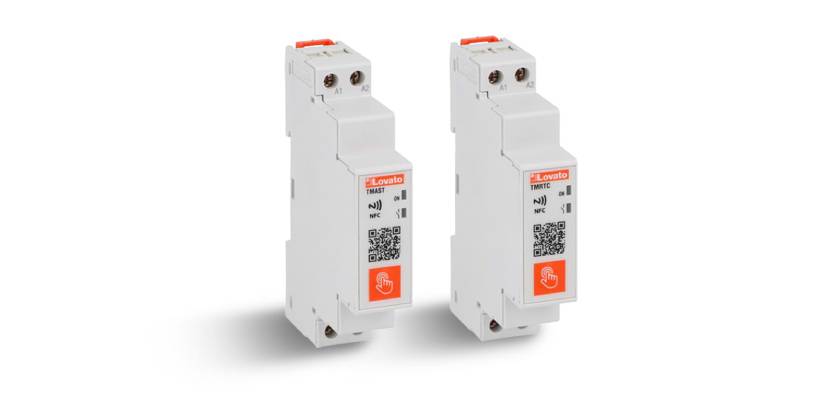
LOVATO Electric expands its range of modular time relays with two new models featuring with an integrated Real Time Clock (RTC) with backup battery and NFC connectivity for programming.
TMRTC is the new weekly time relay, designed to control relay output activation at user-programmable time intervals based on the day and time of the week.
It is used in industrial and civil sectors, such as the control of lightning, the control of air conditioning systems, the activation of sirens or bells and many other functions.
TMAST is the astronomical time relay capable of automatically calculating the sunrise and sunset times for a specific geographical location using configured coordinates.
This information is typically used in applications that need to be automatically activated between sunset and sunrise, with the possibility of programming customized functions.
Both models automatically manage the transition to and from daylight saving time according to the configured time zone, without the need for manual intervention.
NFC connectivity is integrated on the front of the time relays, allowing configuration via NFC with Android and iOS smartphones or tablets with the LOVATO NFC app.
TMRTC and TMAST are equipped with a relay output with NO contact with 16A rating and are supplied with 220…240VAC auxiliary voltage.
They are manufactured in a compact 1-module (1U) housing, suitable for installation on 35mm DIN rails or via screw fixing.
These new devices offer a modern, precise, and reliable solution for controlling simple automations in civil, commercial, and industrial installations.
They combine compactness, robustness, and flexibility with outstanding user-friendliness, ensured through configuration via NFC and app.
More Information
Related Product
DC Miniature Circuit Breakers Type P1MD from LOVATO
Lovato Electric expands its range of protection devices with the new miniature circuit breakers type P1MD, dedicated to DC applications for systems up to 1000VDC.
P1MD are primarily intended for photovoltaic plants to ensure protection against overloads and short circuits of the cables between the photovoltaic panel strings and the inverter. In addition to photovoltaic applications, they can also be used for other DC-1 category loads, such as non-inductive or slightly inductive loads.