Kollmorgen Launches the New Generation of AC and DC Motor Controllers for AGVs and AMRs: Power, Precision, and Performance
May 30, 2025
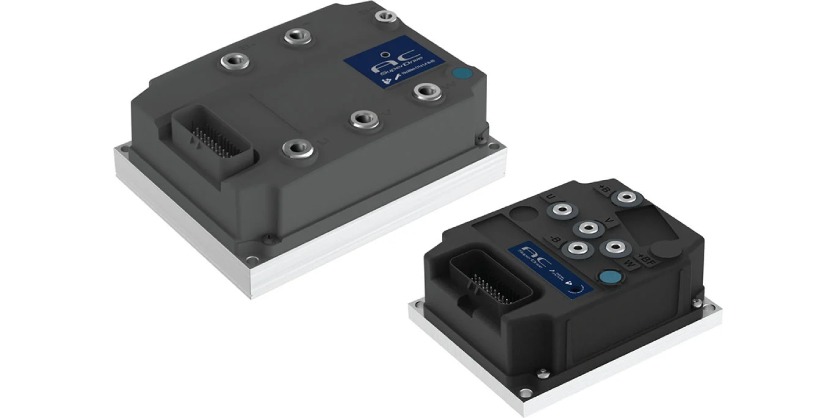
Kollmorgen, a global leader in navigation and controls technology for automated guided vehicles (AGVs) and autonomous mobile robots (AMRs), announces the launch of the AC7 and DC7 Motor Controllers, a powerful new generation of AC and DC motor controllers engineered for AGVs and AMRs. With this innovation, Kollmorgen delivers the performance, durability, and integration flexibility demanded by today’s most advanced autonomous vehicle applications.
The AC7 and DC7 motor controllers are meant for vehicle designers who demand more—from control accuracy to rugged reliability. Both AC7 and DC7 motor controllers feature integrated speed and position regulators for precise control of steering and traction, helping AGVs navigate advanced environments with confidence and efficiency.
Built to Perform
The AC7 motor controllers leverage the latest in AC control technologies to ensure high operating efficiency across a wide power range. Meanwhile, the DC7 motor controllers bring modern DC control techniques to bear, enabling high-precision acceleration and deceleration in both directions. Both families support regenerative braking and are equipped with a feedback interface for incremental encoders.
Engineered for AGV and AMR Environments
Every AC7 and DC7 motor controller is housed in a robust IP65-rated enclosure, offering superior protection against dust, moisture, and physical impact. Integrated mounting flanges and a streamlined connector layout allow for a simple and secure installation in tight vehicle designs.
Seamless Integration with Kollmorgen Ecosystem
Both AC7 and DC7 motor controllers interface directly with other Kollmorgen vehicle products via CAN bus, streamlining system setup and enabling complete motion control synchronization. Designers also benefit from a full suite of general-purpose I/O, along with digital outputs that feature built-in current and voltage control, as well as freewheeling diodes for added reliability.
Key Features of the AC7 and DC7 Motor Controllers
- Built-in speed and position regulators for steering and traction
- Regenerative braking support
- Feedback interface for incremental encoder
- General-purpose I/O with protected digital outputs
- Seamless CAN bus integration with Kollmorgen systems
- IP65-rated enclosure for harsh environments
- Autotuning support (AC7)
With the AC7 and DC7 motor controllers, Kollmorgen shows its commitment to empowering the future of intelligent vehicle automation. Whether you’re building new AGV/AMR platforms or upgrading existing fleets, the AC7 and DC7 motor controllers provide the control foundation to take performance further.
Related Product
Kollmorgen’s New SFD-M High-Resolution Encoder Offers Multi-Turn Absolute Feedback at Zero Incremental Cost
Kollmorgen, a global leader in motion control and automation systems, has introduced the new SFD-M (Smart Feedback Device, Multi-Turn). It allows machine builders to achieve high-resolution multi-turn feedback with absolute positioning information available at system startup.