Rockwell Automation Provides Cost and Space Savings with New Bus Supply Solution
DCS Rockwell Automation Provides Cost and Space Saving with New Bus Supply Solution 1 400

March 22, 2022


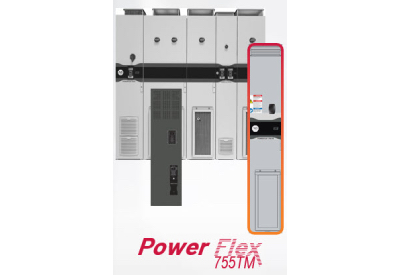
Industrial companies can now benefit from increased space savings and lower costs with a new non-regenerative bus supply. The bus supply is part of the Allen-Bradley PowerFlex® 755TM portfolio. It is a cost-effective solution for a common bus, when regenerative and low harmonics are not required. 

If users have multiple motors, a common bus solution can reduce the size and cost. And customers can save additional cost by using a non-regenerative supply. 

The non-regenerative bus supply converts three-phase AC line voltage to DC. It is compatible with PowerFlex 755TM bus supplies and common bus Inverters. 

Part of the 755T drives portfolio, the non-regenerative supply solutions must be paired with a drive with TotalFORCE® technology to be considered TotalFORCE. But it can also serve as a non-regenerative DC power supply for common bus applications, which is not TotalFORCE. 

The non-regenerative supply is available in 6-Pulse and 12-pulse configurations with XT corrosive gas protection. The distributed DC Bus is located in space saving, modular Rittal cabinets.

This solution works best in industries such as oil and gas, tire & rubber, mining, food and beverage and metals.
DCS Rockwell Automation Provides Cost and Space Saving with New Bus Supply Solution 2 400


To learn more about the new bus supply solution from Rockwell Automation, click here 
 

Related Articles


Editor’s Pick: Featured Article

Weidmüller’s u-control 2000: The Automation Controller

Weidmüller’s u-control 2000: The Automation Controller

Weidmüller’s scalable engineering software, u-control 2000, adapts individually to your requirements. And, the u-control is powerful, compact and fully compatible with Weidmüller’s I/O system u-remote. This article looks at what makes u-control the heart of your automation.

Programmable logic controllers (PLCs) are one of the main components of any automated system. A typical control system has inputs, outputs, controllers (i.e., PLCs), and some type of human interaction with the system, a human machine interface (HMI), for example.

Read More


Latest Articles

  • Applications of Physical AI in Canadian Sectors

    June 23, 2026 Physical AI — the convergence of artificial intelligence with robotics and autonomous motion systems — is reshaping how Canadian industries operate. Across sectors from healthcare to mining, AI-enabled machines are performing tasks that were once entirely dependent on human intervention. But deploying Physical AI effectively requires more than sophisticated algorithms: it demands… Read More…

  • Case Study: Optimizing Harmonic Mitigation in Wastewater Treatment

    June 22, 2026 Segment and Application In a municipality, wastewater treatment plants typically stand out as the main consumers of electricity. The operational processes exhibit significant load variations throughout a 24-hour cycle, necessitating the use of AC drives to regulate pumps, blowers, and other motorized equipment in response to fluctuating demand. In one wastewater treatment… Read More…