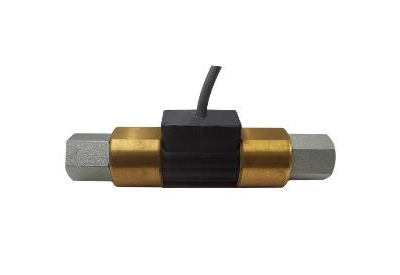
FS-B Bidirectional Flow Switch from Gems Sensors & Controls
DCS Gems Sensors FS B Bidirectional Flow Switch 1 400

February 15, 2022

This inline flow switch is a flow/no flow device with the ability to detect flow in either direction. It is key for applications where detection of flow direction is desirable or where undesired reverse flow is possible and must be prevented to avoid system damage. The FS-B is capable of rigorous application demands, high temperatures, media compatibility, and low pressure drop.


Features and Benefits

  • Direction Indication Inline Flow Switch
  • Ability to detect flow in either direction
  • Key for applications where detection of flow direction is desirable or where undesired reverse flow is possible and must be prevented to avoid system damage
  • Product capable of rigorous application demands; high temperatures; media compatibility; and low pressure drop


Applications:

  • Any closed loop application where direction of flow needs to be indicated
  • Automotive Service Carts
  • Vidirectional Hydraulics

DCS Gems Sensors FS B Bidirectional Flow Switch 2 400


Download the FS-B Bidirectional Flow Switch here

Learn more by clicking here 
 

Related Articles


Editor’s Pick: Featured Article

Weidmüller’s u-control 2000: The Automation Controller

Weidmüller’s u-control 2000: The Automation Controller

Weidmüller’s scalable engineering software, u-control 2000, adapts individually to your requirements. And, the u-control is powerful, compact and fully compatible with Weidmüller’s I/O system u-remote. This article looks at what makes u-control the heart of your automation.

Programmable logic controllers (PLCs) are one of the main components of any automated system. A typical control system has inputs, outputs, controllers (i.e., PLCs), and some type of human interaction with the system, a human machine interface (HMI), for example.

Read More


Latest Articles

  • Applications of Physical AI in Canadian Sectors

    June 23, 2026 Physical AI — the convergence of artificial intelligence with robotics and autonomous motion systems — is reshaping how Canadian industries operate. Across sectors from healthcare to mining, AI-enabled machines are performing tasks that were once entirely dependent on human intervention. But deploying Physical AI effectively requires more than sophisticated algorithms: it demands… Read More…

  • Case Study: Optimizing Harmonic Mitigation in Wastewater Treatment

    June 22, 2026 Segment and Application In a municipality, wastewater treatment plants typically stand out as the main consumers of electricity. The operational processes exhibit significant load variations throughout a 24-hour cycle, necessitating the use of AC drives to regulate pumps, blowers, and other motorized equipment in response to fluctuating demand. In one wastewater treatment… Read More…