Lafert North America: HPS Series Permanent Magnet Motors
March 16, 2021
Hybrid Design for Hybrid Applications
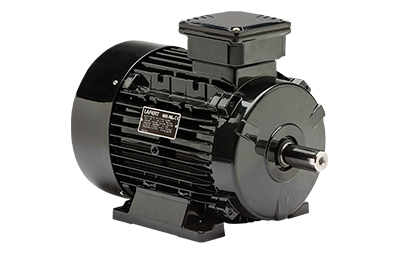
Lafert presents the HPS Series of permanent magnet motors for automated equipment applications where induction motor performance falls short of the mark, or servo motor cost and complexity is impractical. It’s no accident that HPS Series motors are well suited to filling this motor capability gap; the motor construction integrates the cost-effective induction motor stator housing and stator winding with high-performance permanent magnet servo motor rotor technology. The hybrid design is a highly efficient synchronous motor which outperforms induction motors and offers tremendous value for speed control applications. An industry leader in permanent magnet motor technology, Lafert has proudly manufactured HPS Series Motors for over fifteen years. HPS motors are available from stock with standard power ratings to 50 HP for 230, 460, 575 V input. Mounting options include modular base mouths with or without standarized IEC (B5 or B14), and NEMA (C-Face) flanges.
Reduced Losses, Increased Reliability
Energy efficiency has not been a traditional performance consideration for motion control applications, but efficiency has direct reliability and performance implications for motors and systems. All HPS Series motors exceed the current requirements for induction motor efficiency, NEMA Premium®, with motor efficiency performance at or above the “Super Premium” (IE4) level. This increased energy efficiency is due to the permanent magnet rotor construction, which reduces the electrical rotor losses to zero. Induction motor rotor losses are defined as the electrical power converted to heat by current flow (I2R) in the rotor, which typically accounts for 10 – 15% of total losses. Eliminating the rotor losses delivers the dual benefit of increasing energy efficiency and reducing the amount of heat generated by the motor. In simple terms: HPS Series motors create less heat per unit of mechanical power delivered to the load. This explains the reduced thermal rise and thermal time constant, and increased maximum ambient temperature and overload capability of HPS Series motors. The industry rule of thumb, which states that each 10°C rise in motor winding temperature reduces insulation life by half, establishes the case for correlation of reduced HPS Series motor losses with longer field service life. With less waste heat to be eliminated from the enclosure, HPS motors require less material volume and surface area to remain cool. Space and weight savings will vary but in the general case reductions on the order of 50 % can be expected in comparison to equivalently rated induction motors.
High Performance, Without Feedback
Energy efficiency has not been a traditional performance consideration for motion control applications, but efficiency has direct reliability and performance implications for motors and systems. All HPS Series motors exceed the current requirements for induction motor efficiency, NEMA Premium®, with motor efficiency performance at or above the “Super Premium” (IE4) level. This increased energy efficiency is due to the permanent magnet rotor construction, which reduces the electrical rotor losses to zero. Induction motor rotor losses are defined as the electrical power converted to heat by current flow (I2R) in the rotor, which typically accounts for 10 – 15% of total losses. Eliminating the rotor losses delivers the dual benefit of increasing energy efficiency and reducing the amount of heat generated by the motor. In simple terms: HPS Series motors create less heat per unit of mechanical power delivered to the load. This explains the reduced thermal rise and thermal time constant, and increased maximum ambient temperature and overload capability of HPS Series motors. The industry rule of thumb, which states that each 10°C rise in motor winding temperature reduces insulation life by half, establishes the case for correlation of reduced HPS Series motor losses with longer field service life. With less waste heat to be eliminated from the enclosure, HPS motors require less material volume and surface area to remain cool. Space and weight savings will vary but in the general case reductions on the order of 50 % can be expected in comparison to equivalently rated induction motors.
Leveraging Lineage, Learning More
In addition to synchronous operation, HPS Series motors inherits two characteristics from the servo motor with performance implications for motion applications. First, the reduced weight and dimensions of permanent magnet rotors yield higher HPS torque-to-inertia ratios than induction motors. Higher torque-to-inertia ratios are desirable because they supports higher system dynamic response and repeatability. Second, the synchronous motor torque-producing mechanism enables the flat torque curve across a wide speed range and a short-time 300% peak torque capability. Contact us to learn how and why the unique construction and capabilities of HPS Series motors can drive top performance from your next motion control application.