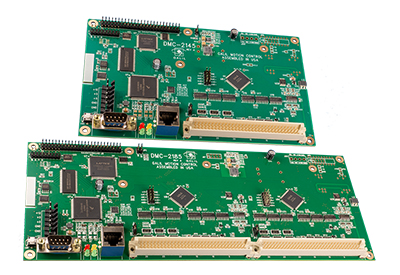
Introducing the New DMC-21×5 Multi Axis Motion Controller From Galil Motion Control
December 21, 2020

The DMC-21×5 is the latest addition to the Econo family and is an easy upgrade path from the long running DMC-21×3 series. The DMC-21×5 utilizes nearly all of the same peripherals as the DMC-21×3 controller, making the transition simple. The main difference between the DMC-21×5 and its predecessor is a state of the art ARM based processor that places its communication, command processing and memory capabilities on par with Galil’s line of current generation motion controllers, while still remaining at the Econo Series price of the DMC-21×3.

The DMC-21×5 is available in one through eight axis formats where each axis is user-configurable for stepper or servo motor operation. Standard programming features include PID compensation with velocity and acceleration feed forward, multitasking for simultaneously running up to eight programs, and I/O processing for synchronizing motion with external events.

Modes of motion include point-to-point positioning, position tracking, jogging, linear and circular interpolation, PVT, contouring, electronic gearing and electronic cam (ECAM).

Like all Galil controllers, the DMC-21×5 controllers use Galil’s popular, intuitive command language allowing for a user friendly interface. Galil’s servo design kit software (GDK Pro) further simplifies system set-up with auto-servo tuning and real-time display of position and velocity information.

For more information, visit HERE.
Related Articles


Editor’s Pick: Featured Article

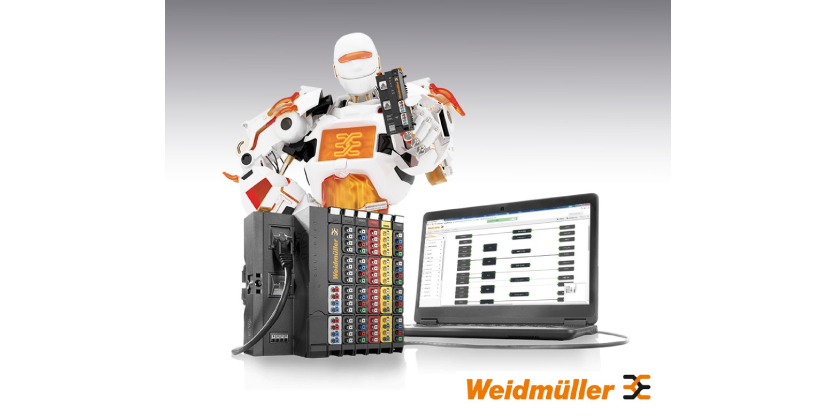
Weidmüller’s u-control 2000: The Automation Controller

Weidmüller’s u-control 2000: The Automation Controller

Weidmüller’s scalable engineering software, u-control 2000, adapts individually to your requirements. And, the u-control is powerful, compact and fully compatible with Weidmüller’s I/O system u-remote. This article looks at what makes u-control the heart of your automation.

Programmable logic controllers (PLCs) are one of the main components of any automated system. A typical control system has inputs, outputs, controllers (i.e., PLCs), and some type of human interaction with the system, a human machine interface (HMI), for example.

Read More


Latest Articles

  • Applications of Physical AI in Canadian Sectors

    June 23, 2026 Physical AI — the convergence of artificial intelligence with robotics and autonomous motion systems — is reshaping how Canadian industries operate. Across sectors from healthcare to mining, AI-enabled machines are performing tasks that were once entirely dependent on human intervention. But deploying Physical AI effectively requires more than sophisticated algorithms: it demands… Read More…

  • Case Study: Optimizing Harmonic Mitigation in Wastewater Treatment

    June 22, 2026 Segment and Application In a municipality, wastewater treatment plants typically stand out as the main consumers of electricity. The operational processes exhibit significant load variations throughout a 24-hour cycle, necessitating the use of AC drives to regulate pumps, blowers, and other motorized equipment in response to fluctuating demand. In one wastewater treatment… Read More…