

Fluke: Pyrometers for High Temperatures and Various Fieldbuses
October 27, 2020

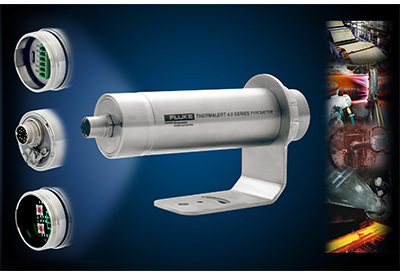
Fluke Process Instruments extends its Thermalert 4.0 spot pyrometer series, adding new shortwave versions and various additional interface options. The compact, extremely robust infrared thermometers provide noncontact, automatic temperature monitoring. Three new spectral models measuring at wavelengths of 1 µm, 1.6 µm, and 2.3 µm have been primarily designed for high-temperature applications and are particularly suitable for monitoring metal, steel, and glass. The full Thermalert 4.0 lineup covers measuring temperatures between -40 °C and 2300 °C and offers various different spectral models and focus distances.

All models are now available with connectivity options for Ethernet, EtherNet/IP, and PROFINET IO, in addition to analog or RS485 interfaces. Voltage can be supplied via Power over Ethernet (PoE). The Thermalert 4.0 series features an outstanding high maximum operating temperature of 85 °C. Users can therefore save costs by setting up many measuring points without cooling. The rugged IP65 infrared thermometers exhibit best-in-class repeatabilities, response times, and accuracies. An integrated laser focus facilitates alignment. In addition, the manufacturer also offers a pyrometer without laser for particularly cost-sensitive applications.

This model with an 8 µm to 14 µm spectral response has all the other advantages of the series and is suitable for a wide range of measurement tasks between -40 °C and 1000 °C.
Source

Related Articles


Editor’s Pick: Featured Article

Weidmüller’s u-control 2000: The Automation Controller

Weidmüller’s u-control 2000: The Automation Controller

Weidmüller’s scalable engineering software, u-control 2000, adapts individually to your requirements. And, the u-control is powerful, compact and fully compatible with Weidmüller’s I/O system u-remote. This article looks at what makes u-control the heart of your automation.

Programmable logic controllers (PLCs) are one of the main components of any automated system. A typical control system has inputs, outputs, controllers (i.e., PLCs), and some type of human interaction with the system, a human machine interface (HMI), for example.

Read More


Latest Articles

  • How Festo is Building the Next-Gen Workforce Through Technical Education & Skills Competitions

    How Festo is Building the Next-Gen Workforce Through Technical Education & Skills Competitions

    July 31, 2026 By Krystie Johnston Festo is a leader in industrial automation and technical education. For decades, they have sponsored SkillsUSA and WorldSkills mechatronics competitions to align education and industry, supporting the workforce of the future. Festo Didactic (the teaching arm of the Festo Group) has been an active participant and sponsor of SkillsUSA… Read More…

  • Driving the Clean Energy Transition with High-Voltage Power Transformers

    July 23, 2026 Utility-Scale Renewable Energy Project, Jan 2026 Project Overview A global renewable energy leader—operating across Europe, North America, and Latin America—continues to expand its portfolio of utility-scale solar and wind projects to accelerate the net-zero transition. With deep expertise in development, investment, and asset management, the organization focuses on delivering long-term, low-risk clean energy… Read More…