Five Things to Consider When Selecting a Safety Light Curtain
May 19, 2020
Light curtains go a long way in making your operations much safer for machine operators and maintenance personnel. That said, simply purchasing and installing one doesn’t ensure that all safety needs are fully met. It’s important to make sure that the light curtain meets all the requirements for reducing the risks of your particular application.
Let’s take a look at five important considerations that should accompany any light curtain specification.
1. What certifications does it have?
Certain basic regulations must be taken into account for all safety products, including standards like ISO 13849-1, IEC 62061 and IEC 61508. These place emphasis on control reliability, diagnostic capabilities, and safety systems architecture.
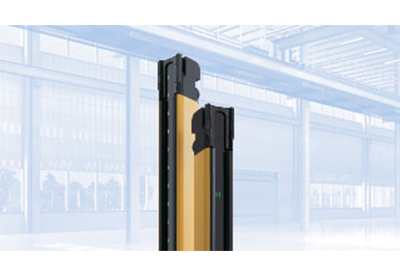
In the case of light curtains, you should also look for additional safety information like the Performance Level (PL) provided by the safety device. Our F3SG-SR Series safety light curtain, for instance, is PL 4. You also need to look for a safety certification from a trusted third party, such as TÜV, that will verify the fulfillment of the previous requirements.
2. What detection capability does it have?
The resolution or detection capability of a light curtain refers to the amount of separation between its laser beams. There are many different resolution options. For example, a 14mm resolution is appropriate for finger detection and is used when the curtain is placed very close to the source of hazardous motion. Hand detection is achieved with a 25-30mm resolution.
3. What’s the minimum safety distance?
According to ISO 13855, you should always calculate the minimum safety distance to determine where to install a safety light curtain. This ensures that once a person activates the light curtain by crossing the detection area, the machine will cease its activity before the person can reach the source of the hazard.
The minimum safety distance calculation takes several parameters in consideration, including the detection capabilities of the light curtain, the total stopping time of the machine, and characteristics specific to the light curtain’s installation. (For more on machine stop time measurements, check out this blog post.)
4. How rugged is it?
Plenty of manufacturing facilities present environmental challenges, including temperatures, excess moisture and other aspects that can easily damage equipment. Light curtains need to be resistant to these pressures. Omron’s F3SG-SR Series, for example, has a wide operating temperature and holds up well in metalworking and food processing applications.
5. What’s the control architecture?
Light curtains are a measure specifically designed for machine safety, but they’re really just a fraction of, and an input to, the overarching safety system surrounding a machine. To build a successful solution, it’s necessary to connect the light curtains to safety control equipment, such as safety relays or safety controllers, that meets the required specifications.