Fitness Tracker for Electric Motors

April 13, 2020

Fitness trackers for people are a genuine success story: more than 40 million are already in use worldwide, helping individuals to stay healthy and improve their fitness. Monitoring and saving vital data like heartrate and blood pressure, the device tracks not only current fitness but also follows an individual’s fitness development over time. Thanks to ABB the principles of a fitness tracker now go beyond people and are being applied to electric motors of any age from many different manufacturers.

Similar to how a fitness tracker works with people, the ABB Ability Smart Sensor provides  more accurate details on the condition and behavior of an electric motor in a working environment.

To gain a better understanding of how these smart devices operate, we visited ABB’s semiconductor factory in Lenzburg, Switzerland. Crucial to the smooth operation of the factory are the ventilation system’s motors, which have to function flawlessly 24/7 because even the tiniest trace of dust in the air could interfere with production.

Data about the motor’s vibration, temperature, magnetic fields and many other parameters are being captured and analyzed by the ABB Ability Smart Sensor, presented with an App in an easy-to-understand format. This vital information ensures that early maintenance work can be coordinated in timely way, enabling ongoing improvements in the motors’ performance. Have a look how it works and what the professionals have to say about it in the video below.

{videobox}zmXUd1lv-ZM{/videobox}
Source

Related Articles


Editor’s Pick: Featured Article

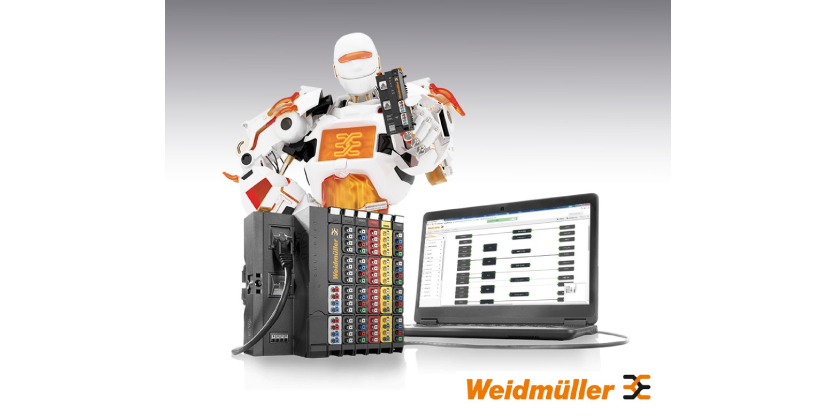
Weidmüller’s u-control 2000: The Automation Controller

Weidmüller’s u-control 2000: The Automation Controller

Weidmüller’s scalable engineering software, u-control 2000, adapts individually to your requirements. And, the u-control is powerful, compact and fully compatible with Weidmüller’s I/O system u-remote. This article looks at what makes u-control the heart of your automation.

Programmable logic controllers (PLCs) are one of the main components of any automated system. A typical control system has inputs, outputs, controllers (i.e., PLCs), and some type of human interaction with the system, a human machine interface (HMI), for example.

Read More


Latest Articles

  • Teaching Machines to See: Why Sensor Fusion Demands a System-Level Approach

    March 16, 2026 By David Doria, Director of Engineering, Automated Driving, Magna Electronics, March 16, 2026 For years, progress in advanced driver assistance systems (ADAS) were driven by improving individual sensors. Higher resolution cameras. Longer-range radars. More precise lidars. Each step delivered incremental gains. But optimizing sensors in isolation only goes so far. As ADAS Read More…

  • Vention Raises the Bar for Automating Automation with New Funding and Solutions

    March 9, 2026 By Krystie Johnston Vention accelerates democratization of automation with new funding and GRIIPTM, sets sites on Enterprise clients, reaches more industries and geographies Vention is on a journey to democratize automation, and they are picking up speed. Already, in Q1 of 2026, they have made two announcements that will accelerate their trajectory Read More…