Baumer: Fasterthanever sensor replacement with the parameter server function
October 15, 2019

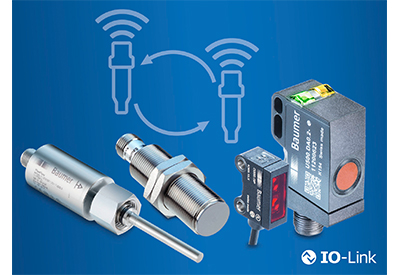
Switching point, switching window, filter, sonic  beam width, output logic: when a new sensor is installed in a machine, a variety of parameters must be adjusted to the application. The parameter server function via the IO-Link interface is the solution for parameter exchange within seconds. This ensures maximum system availability.

The parameter data set is stored in the sensor and redundantly on the IO-Link master as well. If a sensor is replaced by a sensor of the same type, the stored parameter settings can be transferred from the IO-Link master and the new sensor is ready for action within seconds. When the sensor is replaced, this saves valuable time and ensures maximum system availability.

This function is also advantageous when commissioning new machines. Manufacturers who produce large numbers of machines only teach the sensor in once and duplicate the parameter data set from the IO-Link master via the push of a button to other sensors of the same type. Conversely, the sensor can also serve as a backup if the IO-Link master fails, so that the most current status is quickly restored.

The parameter server function is available for Baumer sensors with IO-Link, including the ultrasonic sensors U500 and UR18, optical sensors O200/O300/O500, inductive sensors IR06/08/12/18/30, as well as process sensors such as FlexFlow flow sensors, CleverLevel level switches, or the pressure sensor PP20H.

Further information: www.baumer.com/io-link
Source

Related Articles


Editor’s Pick: Featured Article

Weidmüller’s u-control 2000: The Automation Controller

Weidmüller’s u-control 2000: The Automation Controller

Weidmüller’s scalable engineering software, u-control 2000, adapts individually to your requirements. And, the u-control is powerful, compact and fully compatible with Weidmüller’s I/O system u-remote. This article looks at what makes u-control the heart of your automation.

Programmable logic controllers (PLCs) are one of the main components of any automated system. A typical control system has inputs, outputs, controllers (i.e., PLCs), and some type of human interaction with the system, a human machine interface (HMI), for example.

Read More


Latest Articles

  • Applications of Physical AI in Canadian Sectors

    June 23, 2026 Physical AI — the convergence of artificial intelligence with robotics and autonomous motion systems — is reshaping how Canadian industries operate. Across sectors from healthcare to mining, AI-enabled machines are performing tasks that were once entirely dependent on human intervention. But deploying Physical AI effectively requires more than sophisticated algorithms: it demands… Read More…

  • Case Study: Optimizing Harmonic Mitigation in Wastewater Treatment

    June 22, 2026 Segment and Application In a municipality, wastewater treatment plants typically stand out as the main consumers of electricity. The operational processes exhibit significant load variations throughout a 24-hour cycle, necessitating the use of AC drives to regulate pumps, blowers, and other motorized equipment in response to fluctuating demand. In one wastewater treatment… Read More…