Beckhoff Introduces Frequency Analysis without Programming Requirements
August 17, 2021
TwinCAT Analytics software from Beckhoff offers a complete workflow from acquisition of data through to its storage and analysis to dashboards for continuous machine monitoring. Traditional condition monitoring algorithms are now also available in TwinCAT Analytics using simple configuration with no programming requirements. This addition optimizes both the standard workflow and spontaneous measurements, such as during machine commissioning or service.
Beckhoff presented the TwinCAT Condition Monitoring library as early as 2010. This library includes numerous algorithms that support Moment Coefficients, Discrete Classification and Vibration Assessment according to the ISO standard, in addition to functions such as Magnitude Spectrum, Envelope Spectrum, Zoom FFT, Power Cepstrum and multiple RMS calculations. All functions are available as standard PLC function blocks, which means that condition monitoring functions, for example, for permanent monitoring of bearings or gearboxes, integrate directly and easily into the machine controller.
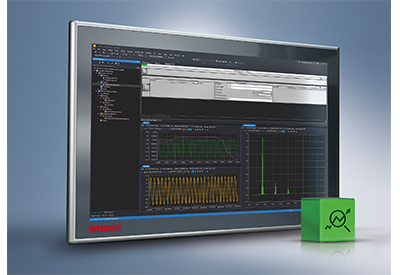
In the past, commissioning staff and service engineers had to invest significant time and effort to calculate a frequency spectrum that would allow selective inspection of machine components, for example. This is precisely where TwinCAT Analytics can help – by reducing a programming task to a simple configuration task. All condition monitoring algorithms are available in the analytics toolbox and can be easily dragged to the Analytics editor and configured. After using the “Start Record” function, the results will then be provided at the output of the algorithms, and they can be displayed clearly and graphically in the charting tool based on the interaction between TwinCAT Analytics and TwinCAT Scope View.
Machine operators and service engineers consequently have an easy-to-use solution at their disposal with the TwinCAT Analytics Service Tool (TE3520) and can interpret the clearly presented results. Continuous monitoring with the aid of the condition monitoring algorithms can be configured just as conveniently in the TwinCAT Analytics Workbench (TE3500) and converted automatically into readable PLC code. This code can then be downloaded onto the local machine controller or remote device to perform the necessary calculations in parallel with the machine application. The TwinCAT HMI visualization solution rounds out the Analytics workflow by automatically creating analytics dashboards.
For more information, visit www.beckhoff.com.