New 20mm Linear Stepper Motor now available from Nippon Pulse
June 6, 2019

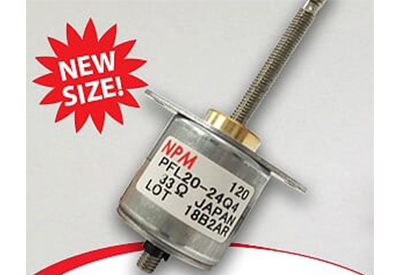
Nippon Pulse is excited to introduce its smallest linear stepper motor yet, the PFL20 Linearstep. The PFL20 is a highly efficient, high thrust tin-can linear actuator with a 20mm diameter and a bipolar winding.

PFL20 is RoHS-compliant, has a 30/60mm effective stroke, and can reach 6 N of force at 200 pps. With 24 steps per revolution, the lead screw has a 1.2mm thread pitch; the PFL20 also reaches 5V rated voltage, resistance of 33 Ohms/phase and inductance of 12mH/phase. The datasheet with additional specifications can be found here.

The simple structure of Linearstep motors – just a threaded rotor hub and lead screw – helps to save space and reduce costs, due to fewer components needed compared to systems that convert rotary motion to linear. Linearstep motors are also easy to control, and can be ordered with unipolar or bipolar windings and a variety of usable voltages. In addition to the 20mm motor size, this motor is also available in 25mm (captive or non-captive option) and 35mm diameter sizes.

Nippon Pulse’s tin-can linear actuators, including the Linearstep, are also available for customization; contact an applications engineer to learn more about our customization capabilities.

Information on the PFL20 from Nippon Pulse can be viewed at:
https://www.electromate.com/assets/catalog-library/pdfs/nippon-pulse/Nippon_Pulse_pfl20_specsheet.pdf

Related Articles


Editor’s Pick: Featured Article

Weidmüller’s u-control 2000: The Automation Controller

Weidmüller’s u-control 2000: The Automation Controller

Weidmüller’s scalable engineering software, u-control 2000, adapts individually to your requirements. And, the u-control is powerful, compact and fully compatible with Weidmüller’s I/O system u-remote. This article looks at what makes u-control the heart of your automation.

Programmable logic controllers (PLCs) are one of the main components of any automated system. A typical control system has inputs, outputs, controllers (i.e., PLCs), and some type of human interaction with the system, a human machine interface (HMI), for example.

Read More


Latest Articles

  • Teaching Machines to See: Why Sensor Fusion Demands a System-Level Approach

    March 16, 2026 By David Doria, Director of Engineering, Automated Driving, Magna Electronics, March 16, 2026 For years, progress in advanced driver assistance systems (ADAS) were driven by improving individual sensors. Higher resolution cameras. Longer-range radars. More precise lidars. Each step delivered incremental gains. But optimizing sensors in isolation only goes so far. As ADAS Read More…

  • Vention Raises the Bar for Automating Automation with New Funding and Solutions

    March 9, 2026 By Krystie Johnston Vention accelerates democratization of automation with new funding and GRIIPTM, sets sites on Enterprise clients, reaches more industries and geographies Vention is on a journey to democratize automation, and they are picking up speed. Already, in Q1 of 2026, they have made two announcements that will accelerate their trajectory Read More…