The Rise of AI in Canadian Manufacturing and Solutions from Schneider Electric
March 25, 2026
By Krystie Johnston
Artificial Intelligence (AI) is not just a buzzword anymore. It is spreading into almost every corner of the world. Okay, maybe not every corner. We know the world is spherical. But it is proliferating into many facets of our daily lives, and automation is seeing a rise in AI-enabled technologies that is changing the manufacturing landscape in Canada. Hugo Lafontaine, Vice President, Industrial Automation at Schneider Electric Canada, shares how almost everything in a factory today can be automated, how these technologies are being used today, and how they will change the future of work. A key takeaway is that AI and automation are not the same thing, but almost any automated task can incorporate AI.
Automation across Canada – the broad strokes
The reality is that, in Canada, and most places, there are different levels of automation. The use of automation depends on the region and the application. It depends on the type of manufacturing. The tools required for a task have a direct correlation to the work that needs to be done. We see these nuances across the country, from mining to oil and gas, forestry, automotive, and original equipment manufacturing (OEM) – each uses some kind of automation, but not every automation is used equally across industries. Collaborative robots are common in the OEM industry but not as popular in mining – at least not yet anyway.
The level of automation is affected by who can do the work. “If you are in an area where there is a significant shortage of labour, you might think that they would be less early in the curve of adoption of AI and technology – but the opposite is true. Because there is a shortage of labour, they need to adapt to that requirement by adopting these technologies faster,” Lafontaine says.
The availability of energy plays a role in the adoption rate of AI-enabled technologies too. The how we do the work. “Energy is super important for manufacturing, depending on what you are doing, you are using more energy or less. All these examples are reasons why we are seeing that automation… And they are really all over the map across the country.”
Approaching the physics of “almost perfect”
Automation is only one half of the equation that models the reality of manufacturing in Canadian factories. Yes, they can use technology to do a task that involves little to no human interference. Integrating AI-enabled technologies into this equation elevates these capabilities exponentially. “I do not think that there is one customer out there who is not wondering, ‘How can I leverage AI?’. In the last couple of months, I am finally seeing discussions like, ‘Wow! I have tried using AI for this, and I am seeing how fast [it is] or how it enables us to do things differently.’ I would say we are finally there,” Lafontaine says.
Within a year, Lafontaine has seen people go from talking about AI and wondering what they can do with it to trying it in different applications. AI is quickly becoming a tool that manufacturers and factories can leverage to ease the pressures like geopolitical and economical instabilities like supply chain issues and tariffs. Not to mention, manage energy efficiency and sustainability in the face of climate change. Lafontaine says that AI-enabled technologies can help businesses adapt quicker to changes like these.
“What we are seeing here [in Canada] right now, is first, economically. Most manufacturing plants are cost-centric. They must ensure they are competitive and that they can produce as much as they can when there is demand. The demand is fluctuating based on an economy that is uncertain. And policies around tariffs are impacting the risk management of these plants and factories – and the manufacturing industry as a whole,” he says. “Policy-wise, I think the government is very clearly engaging in Canada, at both the federal and provincial levels. There are a lot of policies out there to help re-engage the industrial market.”
The one constant in life is change. Canada ‘s capital investments in manufacturing have decreased over the last couple of decades. It is waxing again, and Lafontaine points out.
“Today, you can see a shift in that mentality. I think the time is now where the governments are aligned; investment is starting to come out. Strategies are ensuring that different partnerships across the world are forming, and the developing defense angle shows massive investment.”
He adds, “I think all these things are pointing in the right direction, even if we are seeing some economic challenges right now. Politically and strategically, we are seeing alignment with the manufacturing businesses in Canada.”
Schneider Electric’s AI-enabled solutions
Lafontaine says energy optimization and automation provide an alignment with what our manufacturing needs are within and beyond the Canadian market. They offer higher reliability, more efficiency, and make adaptations for the shortage of labour. “Schneider provides a vast array of tools to meet these needs; it could be metering, cobots, smart PLCs, or edge devices. We are bridging that gap between the energy side and the automation side, because at Schneider, we truly believe that by addressing both, as a manufacturer you can hit the nail on the head when it comes to being competitive and productive.”
This idea extends to Schneider’s philosophy around lifecycle management too. “If you think about a project or operation, it starts from the design, then you move on to the building phase, then you operate your facility, and then you maintain your facility. Those four major pillars are a true lifecycle approach. And the linkage is digital. It is the software,” Lafontaine says. It is the ability to design something, take that data, those drawings, and use them during the building phase. It is transferring them into an operational model or digital twin and leveraging that data to maintain your facility well. And Scheider has a lot of tools to support these pillars of the manufacturing cycle.
Lafontaine says that Schneider’s vision is to help you move from being reactive in maintaining your facility to being proactive. He calls this predictive maintenance. “Having AI enables enterprise data to fix things that are broken – not looking at things that are not broken. It comes down to leveraging digital tools. It comes down to enabling and embedding AI technologies into everything we have today.” He says there is still a long road ahead of us – we are not there yet. “At Schneider, we have enabled AI in many of our tools and software, we have adaptive learning and agentic AI to support the workforce.”
The ripple effect
The AI-enabled technologies available today are already impressive.
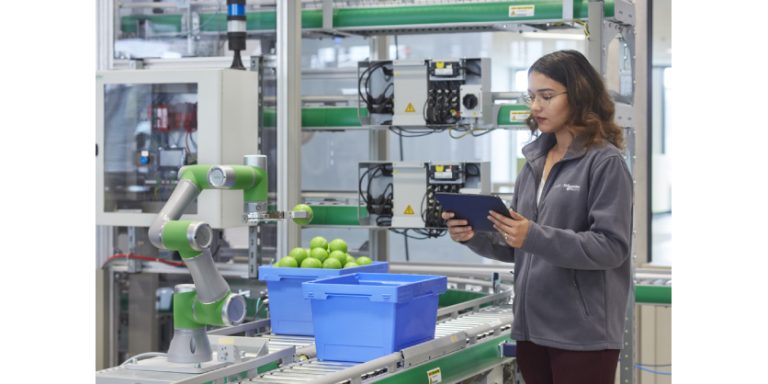
Their amplification over the next couple of years will be incredible. Lafontaine is already seeing these echoes in the advancements of motion control applications. “Cobots, for example, can be leveraged and used in close proximity to humans in a safe manner and they can do highly repetitive works that no workers want to do long term. It is clear that there is a shortage of labour. These cobots and robots are not replacing labour, they are enabling and helping existing workers.”
What Lafontaine also notes is what he calls “the data cube,” Schneider’s vision for centralizing data. At the end of the day, AI does not work without data.
“Data is key. Data needs to be secured. You need to have cybersecurity. You need to have structured sovereignty on your data. You need to make sure that when you design, you are putting in new systems that are open. You need to deal with the fact that you have probably purchased some legacy equipment that is not open. How do you migrate that data? How do you replace that product? All these things come into play. And this is what we offer: a platform that is secure, open and enabled for the customer’s future needs.”
The future of work
But these ripples are not only being noticed in the products themselves or the industries they serve. The future of work is going to be altered. Students in school today are going to be digital natives who were born into a world where the internet, apps, and AI are commonplace. They will still be a need for hands-on skills, but the ideal talent will be a hybrid of both.
“You still need people to be able to be hands-on, but you are going to need to be a bit more rounded, in the ability to be able to deal with hardware, but have that natural instinct around software, around dealing with the embedded tools that are digital like AI and the equipment that you are working on. That is one that I can see a lot more going forward.”
Lafontaine adds that from a pure manufacturing standpoint, there is going to be a lot more electrification. He sees that the transition to electrification is going to continue. “The environment and climate change are not changing. The requirements to hit those targets are going to remain. It is a matter of being sustainable going forward as a country, but also as a planet. These things are not going to change. I see AI being deeply embedded in a lot more of the operational tools -both automation and electrical. It is going to be everywhere.”
“Lasty, I believe the workforce is really going to evolve. You are going to have new digitally enabled students coming in, a new generation with different ways of thinking coming in, and you are going to have the existing and aging generation that have been doing things in the same way. This shift will accelerate the change in how we do things. It will bring a new digital culture, different ways of doing things. Adoption rates around technologies and software are going to increase with the significant shift in profile of this new workforce. This will be one of thematic changes I see in the next 5, 10, 20 years.”
More Information
Interested in learning more? Visit Schneider Electric Canada today.
Related Story
How Schneider Electric Canada is Driving Industries into the Future
Automation, digitalization, IIoT, and AI. Data. Cybersecurity. Sustainability. These are some of the biggest trends in automation that are affecting industries in Canada today and are bound to shape their future, along with such imperatives as labour shortages, and reshoring. Schneider Electric is a leader in technology and was by both Time Magazine and Corporate Knights as the world’s most sustainable company. For decades Schneider has empowered everyone to make the most of their energy and resources. This article explores how they are helping industries in Canada leverage technologies that enable them to be competitive and resilient today and into the future.