World’s first industrial application utilizing 5G and AI adopted at ABB drives factory in Helsinki
July 2, 2019
ABB is piloting the world’s first industrial artificial intelligence (AI) application using 5G wireless technology to support the assembly of drives at its plant in Pitäjänmäki, Helsinki. ABB is implementing the solution in partnership with mobile phone operator Telia and software engineering firm Atostek Oy, which specializes in industrial applications.
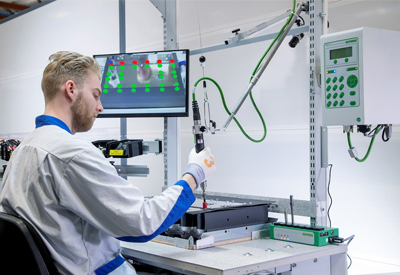
The AI application will support the plant’s workers by monitoring the assembly of the drives by camera and ensuring they are correctly assembled according to a customer’s order and applicable work instructions. The fast 5G connections will provide workers with real-time feedback and this should make assembly significantly easier than following work instructions from a paper document, thereby helping to improve quality.
Atostek is responsible for the computer vision and the AI application. Telia is providing the system’s high-speed 5G mobile connections and providing the computing capacity needed by the application in its data center. The project is being implemented in stages and will be in full-scale production in June 2019.
The application is being applied to the power module assembly line, which is critical to production quality and demanding for employees as dozens of different versions of the same product are assembled on the same line.
“The potential of AI is strongest when combined with human expertise, and the goal of supporting employees in a new way is at the heart of this project,” says Chris Poynter, Group Vice President for ABB System Drives. “At its best, this real-time quality assurance system not only improves production line quality and productivity, but also reduces the stress associated with human errors, which helps improve wellbeing at work.”
5G enables wireless technology to be applied much more widely than has so far been possible and this is expected to significantly boost global production over the next few years. By introducing the 5G AI solution, ABB and its partners are exploring how industrial applications that require high data capacity and high computing power can be implemented in scalable form in the future, regardless of location. For example, the AI application could be integrated with enterprise resource planning systems.
ABB’s drives plant in Helsinki is ABB’s leading unit in the development of low voltage drives. The plant has around 1300 employees. Globally, ABB’s drive business involves around 6,000 employees in a total of over 80 countries.
ABB (ABBN: SIX Swiss Ex) is a pioneering technology leader with a comprehensive offering for digital industries. With a history of innovation spanning more than 130 years, ABB is today a leader in digital industries with four customer-focused, globally leading businesses: Electrification, Industrial Automation, Motion, and Robotics & Discrete Automation, supported by its common ABB Ability™ digital platform. ABB’s market‑leading Power Grids business will be divested to Hitachi in 2020. ABB operates in more than 100 countries with about 147,000 employees.